Event Technology: What to know in 2026?

Event technology helps organizers transform events into more streamlined, engaging, and successful experiences. From tools that simplify planning to apps that enhance attendee interaction, the right technology makes all the difference. In this article, discover the top event technology trends for 2026, practical examples, comparison criteria, and a checklist for choosing the right event tech platform.
What is event technology?
Event technology is the set of tools, apps, and software used to plan, run, and measure events, including registration and ticketing, mobile event apps, attendee engagement and networking tools, virtual and hybrid platforms, AI personalization, and analytics. It helps organizers streamline logistics, boost attendee engagement, and prove event ROI.
Key Takeaways
- Embrace event technology to streamline planning and enhance attendee experiences, driving satisfaction and engagement.
- Stay ahead of trends like AI personalization, VR/AR integration, and sustainability to create memorable, impactful events.
- Choose event tech solutions that align with your workflows, fostering collaboration and ensuring a smooth event experience.
Event Technology Explained
Event technology encompasses the tools, apps, and software employed to plan, execute, and measure events. These innovations have transformed the events industry by streamlining the planning process through data-driven solutions. Event professionals increasingly depend on virtual, hybrid, and digital in-person events to address diverse audience needs, resulting in hassle-free and safer experiences for everyone involved. An effective event strategy is essential for maximizing these benefits.
Event technology's impact on the industry is significant, supporting collaboration by streamlining information flow and organizing tasks among stakeholders. This consolidation saves time and money while boosting the chances of achieving event goals. Industry research from Cvent and Edelman Intelligence highlights the role of personalization, mobile technology, and networking in stronger attendee engagement, while Encore's 2026 experience design research points to structured networking as a major driver of live event value.
Event technology also enhances planning by providing practical tools and reducing guesswork for organizers. These innovations aim to improve the attendee experience, reflecting positively on the brand and organization. From management software to mobile event apps, the right event technology solutions can elevate the entire attendee journey. Explore mobile event app solutions to see how technology can transform your events.
Examples of Event Technology
Event technology is most valuable when it solves practical problems across the full event lifecycle. The right mix of tools can help planners create stronger attendee journeys while giving internal teams cleaner data and fewer manual tasks.
- Registration and check-in: Digital registration, badge scanning, QR codes, and access controls reduce queues and keep attendee data accurate.
- Mobile event apps: Personalized agendas, live updates, maps, notifications, Q&A, and polling help attendees navigate the event and participate in real time.
- Networking and matchmaking: Attendee profiles, recommendations, chat, meeting booking, and discussion forums make it easier for people to build relevant connections.
- Marketing and communications: Email, push notifications, event websites, and segmented messaging help promote sessions and keep attendees informed before, during, and after the event.
- Analytics and reporting: Engagement data, session attendance, survey responses, and lead capture help teams understand what worked and where to improve.
Why Event Technology Is Important
Event technology is important because it improves both the planning process and the attendee experience. For organizers, it reduces manual coordination, centralizes information, supports collaboration, and gives teams measurable insights into event performance. For attendees, it makes events easier to navigate, more personalized, and more interactive.
The right technology can also make an event feel more modern and memorable. When attendees can build their own schedule, receive timely updates, connect with relevant people, and share feedback without friction, they are more likely to stay engaged and see value in the experience.
The Role of Technology in Event Management
Technology touches every stage of the event lifecycle: planning through registration, budgeting, and scheduling; promotion through email, social media, and landing pages; delivery through mobile apps, check-in, and live engagement; and measurement through analytics, attendee feedback, and ROI reporting.
The result is less manual work, fewer errors, richer attendee data, and clearer proof of success. That is why many organizers now treat event management technology as core infrastructure rather than a nice-to-have tool added late in the planning process.
Leveraging Event Technology for Enhanced Experiences
Event planners today have a powerful arsenal of tools at their disposal to create customized event experiences that resonate with their audience. Utilizing attendee preferences allows planners to boost attendee engagement. Social media platforms play a critical role in engaging attendees and fostering event-specific communities. Through live polling, AI chatbots, or virtual and augmented reality, the objective is to craft unforgettable experiences that keep attendees engaged.
In-person events benefit from technology like event apps, which provide personalized schedules, interactive maps, and timely updates. These mobile event apps facilitate seamless navigation and real-time communication, making the entire event experience more interactive and engaging. Hybrid events leverage both virtual and in person event interactions, ensuring an immersive experience for all attendees.
Modern technology investment transforms virtual events into engaging experiences. Platforms with live streaming and participation options significantly boost attendee engagement. AI chatbots offer immediate assistance, enhancing the overall attendee experience. Incorporating event technology continues to expand the number of virtual events and virtual event attendees globally.
How To Choose the Right Event Tech
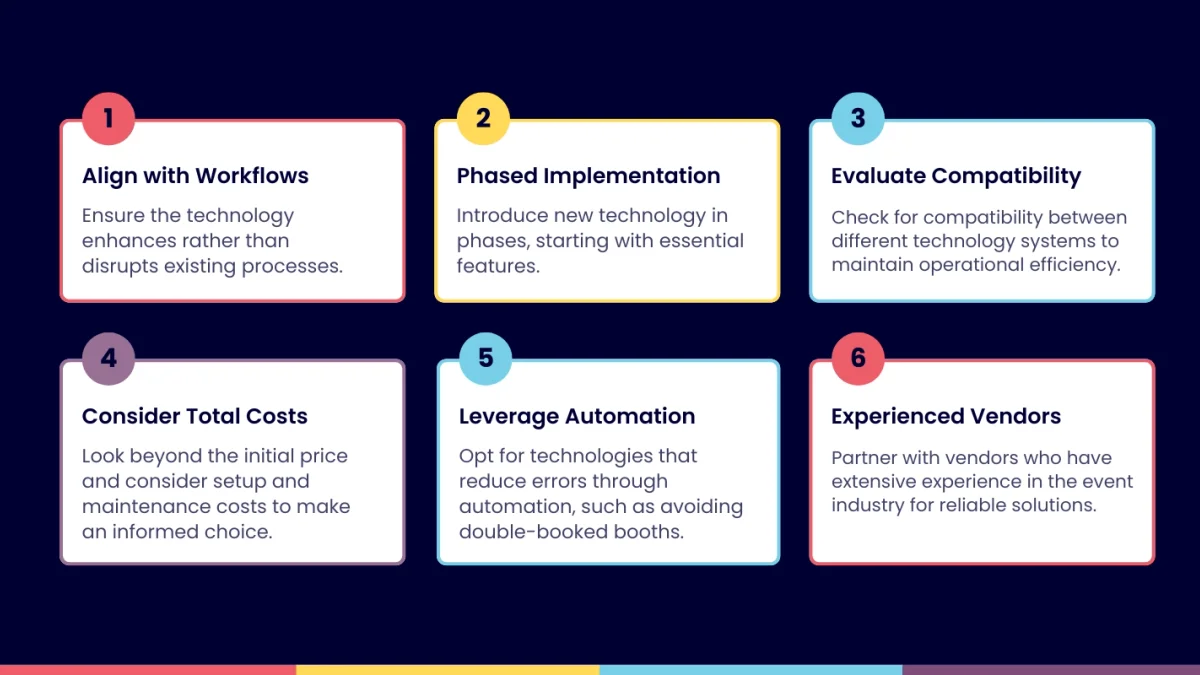
Selecting the appropriate event technology can be daunting, but a structured approach can simplify it:
- Align with Current Workflows: Ensure the technology enhances rather than disrupts existing processes.
- Phased Implementation: Introduce new technology in phases, starting with essential features.
- Evaluate Compatibility: Check for compatibility between different technology systems to maintain operational efficiency.
- Consider Total Costs: Look beyond the initial price and consider setup and maintenance costs to make an informed choice.
- Leverage Automation: Opt for technologies that reduce errors through automation, such as avoiding double-booked booths.
- Experienced Vendors: Partner with vendors who have extensive experience in the event industry for reliable solutions.
Considering these factors helps event planners choose the right technology that aligns with their goals and enhances the overall event experience.
Key Factors When Choosing Event Technology
Once you know your event goals, use a clear evaluation framework to avoid buying tools that look impressive but do not fit your team or audience.
- Hybrid compatibility: Confirm the platform can support in-person, virtual, and hybrid experiences without forcing separate workflows.
- User-friendliness: Choose tools that are simple for planners, speakers, sponsors, and attendees to use without heavy training.
- Reliability: Look for proven uptime, event-day support, and references from organizations running similar events.
- Accessibility: Prioritize mobile compatibility, multilingual options, readable interfaces, and inclusive attendee experiences.
- Security: Make sure attendee data is protected through appropriate permissions, privacy controls, and secure integrations.
- Support quality: Evaluate onboarding, documentation, customer success availability, and response times before the event is live.
Event Technology Comparison: What Each Tool Solves
Most event teams do not need every possible tool. They need the right mix for their audience, event format, and reporting goals. Use this comparison as a quick way to decide what belongs in your event technology stack.
| Technology | Best for | What to check |
|---|---|---|
| Mobile event app | Schedules, notifications, maps, networking, live polling, and attendee engagement | Offline access, branding, analytics, integrations, and ease of attendee adoption |
| Registration and check-in software | Ticketing, attendee data capture, badge scanning, access control, and queue reduction | Payment support, CRM sync, privacy controls, onsite reliability, and reporting exports |
| Hybrid event platform | Streaming, remote attendance, virtual sessions, and digital sponsor experiences | Latency, accessibility, moderation, engagement features, and content reuse after the event |
| Networking and matchmaking tools | Connecting attendees, sponsors, speakers, and prospects around shared interests | Profile quality, meeting booking, recommendations, privacy settings, and post-event follow-up |
| Reporting and analytics | Measuring attendance, engagement, session popularity, lead capture, and event ROI | Dashboard clarity, export options, attribution, CRM integration, and real-time visibility |
Key Trends Shaping Event Technology in 2026
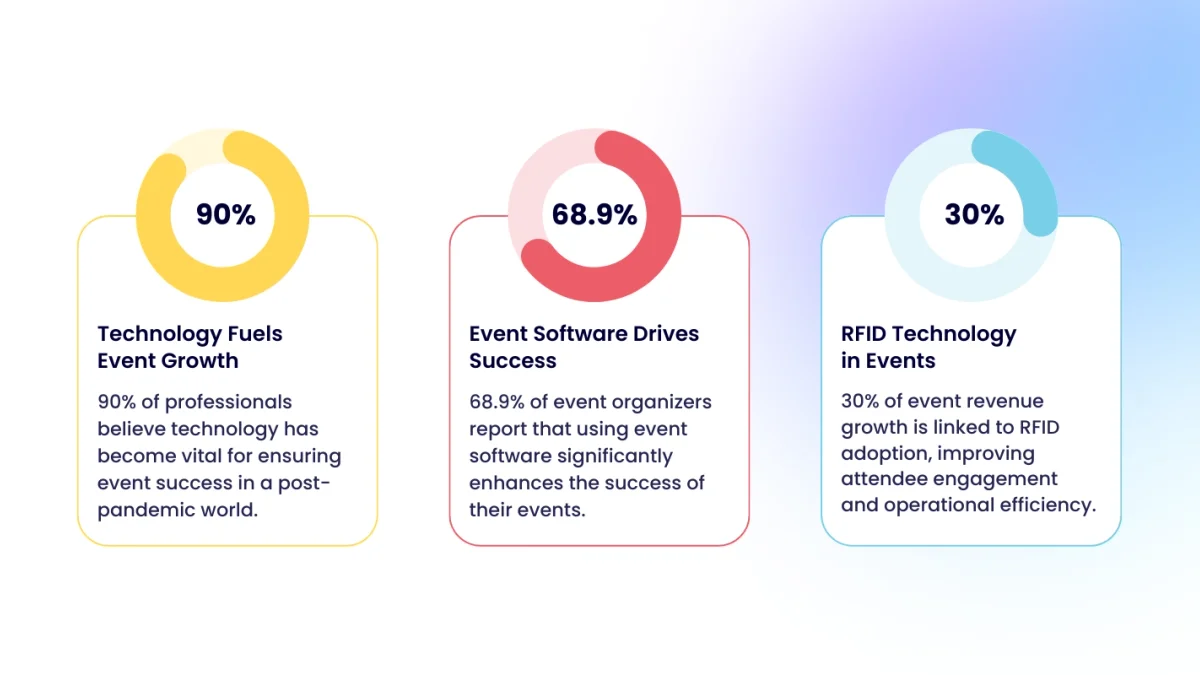
The events industry is undergoing a significant transformation as planners use technology to make experiences more personalized, measurable, and flexible. Rather than treating event tech as an add-on, high-performing teams are using it to connect registration, engagement, networking, sponsor value, and post-event reporting.
Among the most notable trends are the integration of digital twins, AI, virtual reality, and a strong focus on sustainability. Digital twins allow event planners to create virtual simulations of event setups, reducing the need for physical prototypes and minimizing waste. This technology also enables real-time performance monitoring, helping to optimize resource usage and lower energy consumption.
AI, virtual reality, and sustainability are set to significantly reshape the industry, with many planners prioritizing eco-friendly practices and venues.
AI-Powered Personalization
Artificial Intelligence (AI) is transforming event planning by providing personalized experiences and recommendations based on attendee preferences and behavior. AI-powered solutions generate insights into the entire attendee journey, helping create more tailored experiences. Tracking attendee preferences and behaviors allows planners to tailor experiences to individual needs, ensuring a more engaging event.
Additionally, AI improves communication and engagement by streamlining event-related content creation. AI chatbots provide 24/7 assistance to attendees, ensuring their needs are met throughout the event. Utilizing AI in event planning streamlines key touchpoints, improves security, and enhances the overall attendee experience.
Virtual and Augmented Reality
Virtual reality (VR) and augmented reality (AR) are revolutionizing events by offering immersive and interactive environments for attendees globally. These technologies allow attendees to explore virtual venue tours, participate in interactive sessions, and engage with content in a more dynamic way. Recent advancements have made VR and AR more affordable, increasing their accessibility for a broader range of events.
The integration of VR and AR into event planning offers numerous benefits. For example, VR can create virtual simulations of event setups, while AR can enrich in-person experiences by overlaying digital information onto the physical world. These technologies not only boost attendee engagement but also create memorable experiences that resonate long after the event concludes.
Contactless Solutions
Facial recognition technology is revolutionizing event check-ins by expediting registration processes and significantly enhancing security. This technology enhances the attendee experience by allowing for faster entry and exit at the venue. However, it is crucial to obtain attendee consent to address privacy challenges associated with facial recognition.
RFID technology is another contactless solution gaining traction. RFID wristbands and badges gather attendee admission data, detect security access, and streamline entry processes. These technologies provide cost-effective data collection and validate event success.
Overall, contactless check-ins enhance safety and streamline logistics, reducing queues and improving the overall attendee experience.
Top Event Technologies
Mobile Event Apps: A Must-Have Tool
Mobile event apps have become essential for modern events, providing attendees with instant access to schedules, networking opportunities, and real-time updates. These apps enhance engagement through features like live polling, Q&A sessions, and interactive maps. Mobile event apps also facilitate communication between attendees, speakers, and organizers, creating a more connected event experience.
For event organizers, mobile apps offer valuable analytics and insights into attendee behavior, helping to measure event success and identify areas for improvement. These apps can also reduce costs and environmental impact by eliminating the need for printed materials and reducing waste by eliminating the need for on-site support staff for announcements. Consider using an event website to complement your mobile app strategy.
Enhancing Networking Opportunities with Event Tech
Event technology has greatly enhanced networking opportunities, enabling better user experiences and instant connections among attendees. Features such as matchmaking systems and virtual networking events enhance connections among attendees, speakers, and sponsors. These advancements foster connections, community, and meaningful conversations, leading to improved networking outcomes.
Integration of social media within event platforms fosters collaboration and valuable networking exchanges. Advanced analytics in event tech allows organizers to track engagement patterns, leading to more effective networking opportunities.
In 2026, measuring the strength of relationships, known as Return on Relationships (ROR), will be crucial for event success.
Event Registration Software: Simplifying Sign-Ups
Event registration software simplifies the sign-up process for events. Cloud-based event management software aids in automating time-consuming tasks, allowing organizers to focus on essential aspects of event planning. This software also centralizes attendee data, making tracking and managing information more efficient. Automating tasks with this software saves time throughout the event planning process and enhances the effectiveness of event management tools, including event websites and an event website.
Modern registration software often integrates seamlessly with payment gateways, streamlining the financial aspect of event management. These tools ensure compliance with data protection regulations, enhancing attendee information security. Many event registration tools now feature mobile-friendly interfaces, making it easier for attendees to sign up and access information on the go.
Sustainability Through Event Technology
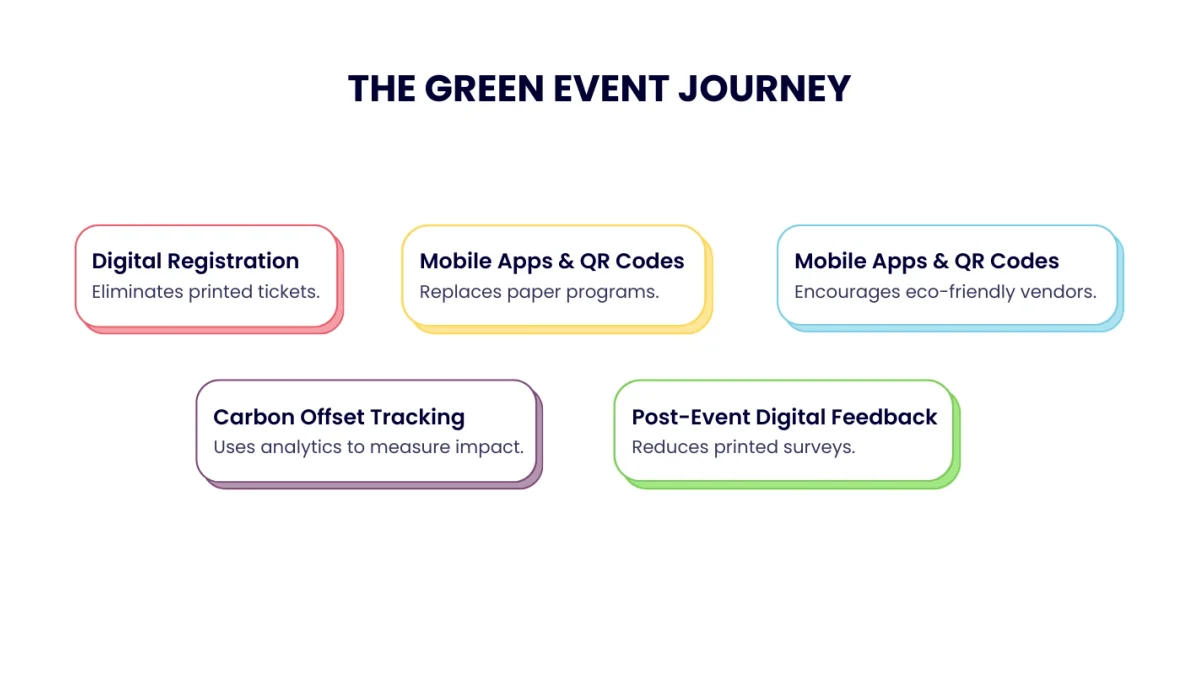
Sustainability is becoming a cornerstone in event planning, with technology solutions playing a crucial role in driving this change. Mobile event apps offer digital information access, significantly reducing paper usage during events. Digital registration further reduces environmental impact by minimizing the need for printed materials. These eco-friendly practices reduce waste and align with global initiatives to lower environmental footprints.
Key sustainable practices in event planning include minimizing carbon footprints, using sustainable materials, local sourcing, recycling, and composting. The future of event planning hinges on integrating innovative event technology solutions that prioritize sustainability. Adopting these technologies enables event planners to host successful events while promoting environmental responsibility.
Event Marketing Technology for Business Growth
Event marketing technology is vital for driving business growth and audience engagement. Email marketing tools like MailChimp, HubSpot, and Constant Contact facilitate personalized event messaging and targeted promotions. These tools enable event planners to capture insights throughout the attendee journey and optimize event strategies for better outcomes. Social media enhances event marketing by promoting events through attendee-generated content and fostering interaction across platforms. Learn how event apps can enhance your marketing efforts.
Data analytics is crucial in event marketing technology, enabling marketers to make informed decisions based on attendee behavior and preferences. Using these digital tools, event planners can create more effective marketing campaigns, resulting in increased attendance and business growth. Integrating social media platforms, email marketing tools, and data analytics ensures a comprehensive approach to event marketing. Learn more about event reporting to track your marketing success.
How To Find the Best Event Tech
To compare event technology platforms, start with your must-have use cases and then review trusted comparison sources such as G2, Capterra, and Trustpilot. Ratings are useful, but the best fit usually comes from reading reviews that mention your event type, team size, integrations, support expectations, and attendee experience goals.
When comparing platforms, look at total value rather than feature count alone. A tool that combines an event website, registration, attendee engagement, mobile app experiences, and analytics can often reduce complexity compared with stitching together several disconnected point solutions.
Event Technology Checklist Before You Buy
Before you commit to a platform, pressure-test it against the real event workflow. A strong demo should show how the tool performs before, during, and after the event, not just how polished the interface looks.
- Map the attendee journey: list every attendee touchpoint from registration to post-event follow-up.
- Confirm ownership: decide who updates content, sends notifications, resolves support issues, and reviews analytics.
- Test integrations: verify CRM, marketing, payment, calendar, and data export requirements before launch week.
- Run an event-day rehearsal: check login, check-in, notifications, live polls, Q&A, and reporting in realistic conditions.
- Define success metrics: choose the attendance, engagement, lead, sponsor, or satisfaction metrics you will report after the event.
Partnering with Event Technology Vendors

Choosing the right event technology vendors is crucial for hosting successful events. When selecting vendors, consider functionalities and innovative features that meet your event's specific needs. Prioritizing customer support and success tools can improve your decision-making process. Effective communication with vendors during planning can prevent miscommunication and minimize errors.
Researching key factors and choosing vendors with extensive event industry experience ensures reliable support and innovative solutions. Prioritize best-in-class support and quick issue resolution when selecting technology providers.
Using a single event platform can boost collaboration, reduce miscommunication, and enhance overall planning efficiency. Seamless integration with existing systems and payment processors ensures secure online transactions and smooth operations.
How Fliplet Supports Event Technology in 2026
Fliplet Events helps teams manage event technology from one flexible solution. Your team can run Registration and check-in, Agenda and content delivery, attendee engagement, networking, sponsor and lead capture, reporting, integrations, branding, and secure access controls. It works for conferences, retreats, internal events, and client events.
That flexibility helps organizations create branded event experiences without rebuilding their setup for every event. Whether you are running a conference, internal event, client event, or retreat, Fliplet Events supports attendee engagement before, during, and after the event. Book a demo to see Fliplet Events in action.
Summary
In summary, the event technology landscape in 2026 is marked by innovations that enhance attendee experiences, streamline planning processes, and promote sustainability. From AI-powered personalization and virtual reality to contactless solutions and mobile event apps, these technologies are transforming how events are planned and executed. By staying abreast of the latest trends and effectively leveraging event technology, event planners can create unforgettable experiences that drive business growth and leave lasting impressions. Embrace the future of event technology and take your events to new heights.
Looking to take advantage of these event tech trends? A flexible event platform can help you combine planning, engagement, communication, and reporting in one branded experience. Book a demo to see how Fliplet can help make your next event more connected and easier to manage.
Lisa Broom is the Content Writer and Head of Marketing at Fliplet - an app building platform that enables anyone to easily create engaging and interactive mobile and web apps.
Frequently Asked Questions
What is event technology?
Event technology is the set of tools, apps, and software used to plan, run, and measure events. It includes registration and ticketing, mobile event apps, attendee engagement and networking tools, virtual and hybrid platforms, AI personalization, and analytics.
What are the latest event technology trends?
The latest event technology trends include AI personalization, VR and AR experiences, contactless check-in with facial recognition or RFID, digital twins for planning, sustainability tooling, mobile-first engagement, and stronger event analytics.
What is event management technology?
Event management technology is software that automates the operational side of events, including registration, attendee data, scheduling, payments, check-in, communication, and reporting. It is usually delivered as a single platform or a connected stack.
What technology is needed for an event?
Most events benefit from registration software, access or check-in tools, a mobile event app, attendee communication channels, networking features, and reporting software. Larger events may also need hybrid streaming, lead capture, sponsor tools, and integrations with CRM or marketing systems.
Why is event technology important?
Event technology improves efficiency, reduces manual work, enhances attendee experiences, and gives organizers better data for measuring success. It also helps teams personalize journeys, respond quickly during live events, and make better decisions after the event.
How can I choose the right event technology for my event?
Start with your event goals, format, audience size, integrations, support needs, accessibility requirements, and budget. Prioritize tools that are easy for attendees to use, reliable on event day, secure with attendee data, and compatible with your existing workflows.
How does event technology improve attendee engagement?
Event technology improves attendee engagement through personalized agendas, push notifications, live polling, Q&A, matchmaking, gamification, mobile event apps, and real-time feedback. These tools make it easier for attendees to participate, connect, and find the most relevant parts of the event.
Where can I compare event technology platforms?
Review sites such as G2, Capterra, and Trustpilot can help you compare event technology platforms. Look beyond star ratings and assess support quality, ease of use, security, integrations, pricing, and whether the platform supports your event format.
![30 Best Mobile Event Apps and Conference Apps [2026] blog thumbnail](/images/blogs/25-best-mobile-event-apps/fliplet-events-solution-image.avif)